Sunday, August 23, 2009

Finished: White Concrete Desk Project

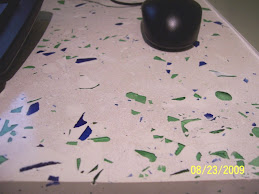
The white concrete desk is completed and installed. The cobalt blue and green bottles with the white sand and cement really pops.
The hole for the computer cables was drilled after the desk was installed. I was concerned about the hole breaking during installation otherwise. Some minimal fitting was required to get everything to slide into place.
A completed, very cool, built-in desk.
Next Project: Illuminated bar top
The next project is going to be a bar/buffet top with crushed glass and fiber optic lighting.

Sunday, August 9, 2009

Finishing the White Desk

The white concrete desk was placed two weeks ago. Form were stripped after 4 or so days. Initial grouting was done at 4 days and moist cured. Initial grinding 50 and 100 grit was done at 7-days. A second thinner grout was applied with a rubber trowel. The countertop was moist cured for another 7-days until polishing. At 14 days after placing the top was polished through 1500 grit. So the full polishing scheme went 50, 100, 200, 400, 800, and 1500. I skipped 3000 grit since the sealer doesn't really stick to it. Four coats of sealer went on today. The sealer will cure for another day (it is really hot and humid in the garage right now) and will get waxed before installation.

Monday, August 3, 2009

Desk Progress

The desk got one thick coat of slurry right after the forms were removed. Then the top was ground through 50 and 100 grit before applying a second much thinner coat. It will cure another week before beginning to polish. All of the glass stayed in placed and looks good.

Thursday, July 30, 2009

White Concrete Desk Reveal

One of the characteristics that helps lighten white cement is fine grinding, even finer than Type III high early strength cement. I will vouch for that. This countertop was hot to the touch 6 hours after placing. Good news is that it can be finished much sooner.
The desk proved difficult to strip the forms since the aggregate was glued in place. The glass stayed in placed and was well distributed across the surface. In this picture I started slurry coating the surface to fill the holes left from the curved part of the glass. In a day or so it will get a grind with 50 grit and then another slurry coat.

Monday, July 27, 2009

Placing the White Desk

To get the colored glass, blue and green wine and beer bottles were soaked in water to remove the labels then crushed and rewashed. The mold was sprayed with glue to hold the glass in place.
All the ingredients, all white. Sand, cement, metakaolin, and latex.

I stripped a couple sides. It will cure under a wet towel for four days before grinding and another week before polishing.

Saturday, July 25, 2009

White Desk Project

Everything has been prepared for the white desk. The mold is a pretty standard construction. I had some leftover MDF so I used that and spray painted to seal the wood. The desk has a thickened front edge to cover the in-place frame.
The desk will be white concrete with crushed glass in the surface. I saved some good blue and green bottles. First they were soaked in water to remove the labels, then crushed with a hammer to the appropriate size. Beer bottles can be problematic if not cleaned properly. The sugars in the beer tend to retard the concrete set. These were washed again after crushing.
How do you make white concrete, mmm use white cement. This is a little harder to track down for the average person since Home Depot doesn't carry it. Masons and stucco guys use white cement or call your local decorative supplier. This cement and sand was donated by Mike Murry at Decorative Concrete Supply. The only real difference between white and regular Portland cement is they leave out the tetracalcium aluminoferrite. It is a small part of regular cement that doesn't really contribute to strength.
Another concern for making white concrete is the aggregate. Regular sand tends to make the white cement concrete a tanish color. You can buy pure silica sand (ash tray sand) at local suppliers. Since this is a small desk, shrinkage isn't really a concern so a mortar mix is appropriate.
The mix will be a standard mortar mix; 2.5:1 sand to cement, water-to-cement 0.40, 10% metakaolin clay, high range water reducer, viscosity modifier, latex, polypropylene fibers, cellulose fibers, and de-air entraining agent. The total batch will be 1.0 cf.

Wednesday, July 8, 2009

White Concrete Desk Project

Since the last project was black, time to do something white. We built a closet in our guest bedroom and left room between the window and the closet for a built-in desk. The room is green with orange accents and blond birch trim. The plan is to build a white concrete countertop for the desk with exposed blue and green recycled glass.
Below is the black fireplace with the slate tile and new carpet.
Wood strips were secured to the studs to support the plywood top and eventually the concrete. There is a hole in the back right for cords. The countertop will be 1 1/2" thick and cap the front to end up flush with the wall. Truly white ground concrete is a difficult animal. First, you have to use white cement. Second, traditional aggregates have color and tend to make the concrete grey or tan, so you have to use something else. This mixture will be a mortar (no coarse aggregate) and have white cement with pure silica sand. Silica sand is often used as ashtray sand. Some metakaolin clay (a bone white SCM) will add strength. Blue and green bottles will be crushed and laid into the surface. It should produce an interesting effect.