Wednesday, March 10, 2010

Concrete Planter Project (1. Mold Making)

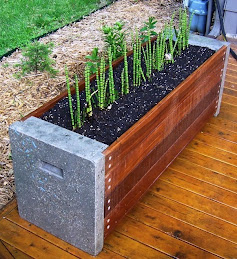
The recent warmer weather has a few projects starting around the house. I am building raised beds for the garden out of ipe wood and have some extra material. I have enough extra to build a couple concrete and ipe planters. Ipe is a very hard, very dense tropical wood that makes great patio furniture.
Mold making for concrete countertops/projects has evolved recently (past 10 years). Cheng started using particle board and laminate then switched to melamine. Every project used fresh mold materials and used lots of drywall screws to keep things from moving. Lately Cheng has switched to foam boards secured with tape. Many other mold builders have switched to foam board and thick vinyl tape for lining the molds. Others have switched to fiberglass or flexible urethane molds. It turns out that most of the older style molds were over-built and wasted too much material. I have built a couple molds lately with little to no screws.
Here is one of the end molds for the concrete planter. It is basically square with knockouts to secure the wood pieces and a handle indentation. Other than a few leftover screws holding together the bottom knockout, there aren't any in this mold.
For the sides I cut the bottom melamine used for the fiber optic topic and sealed the ends with polyurethane. The mold pieces are held down with silicone caulk. Brown was on sale. The knockouts are just leftover plywood coated with polyurethane.
Instead of screwing the braces into the bottom piece and sides, they are secured with caulk too.
A couple minutes later the mold is complete. I let the caulk dry and then fill the seams. After casting the concrete everything comes apart and cleans up easily.
These ends are 4 inches tall and will be held just fine with caulk. The fireplace mold was secured with caulk because I didn't want to drill into my floor. That was 12 inches tall and didn't move at all. Using this technique I can reused my mold pieces and the bottom won't have a scratch.

Monday, March 1, 2010

It's Winter, blah!

I haven't posted in a while because, well it's winter and I haven't done anything. Spring is getting close and thoughts of drinking on the patio are surfacing. One of the first projects for the new year is a table for the patio. I picked up this tulip base last year. It is going to get a green concrete top. I am toying with the idea of embedding steel and letting it rust through the surface.

Wednesday, December 9, 2009

Concrete that looks like, asphalt?

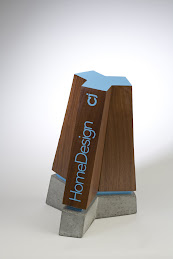
A month or so ago Studiobuild was contacted by a Ferrari race team to make a couple trophies for their series championship. The catch was they wanted the bases made out of asphalt. Besides my aversion to asphalt, the logistics of an asphalt trophy just didn't' work. So I suggested the next best thing, a concrete base the looks like asphalt. Jerad made the mold and I went to work on the mix. I took a superpave asphalt mix design and substituted black cement paste with appropriate viscosity for the liquid binder. I even compacted them with a Marshal hammer. After coating with a high gloss sealer, the results look just like asphalt. Never thought I would imitate asphalt with concrete, but it worked quite well.

Monday, November 23, 2009

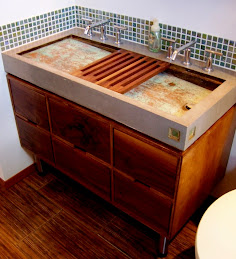
Concrete Fiber Optic Buffet Top

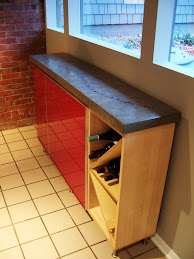
The fiber optic buffet top got installed this weekend.
The finish ended up being a coat of the semi-penetrating soy epoxy. Since it ended up being very shiny I hit everything with some steel wool and then a coat of wax.

A couple layers of felt went down to provide some support for the fiber optic cables under the concrete.
Ooooooo
Ahhhhhhh

Friday, November 20, 2009

Sealing the Concrete Buffet Top

I have been falling behind on blog posts with our house being on a homes tour, traveling, and school. Meanwhile the concrete buffet top has been sitting and waiting in the garage. Pretty much all of the finish work has been completed so it getting old didn't impact grinding. Although at this point there isn't anything you could do other than burn up pads.
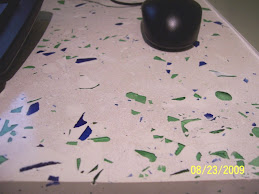
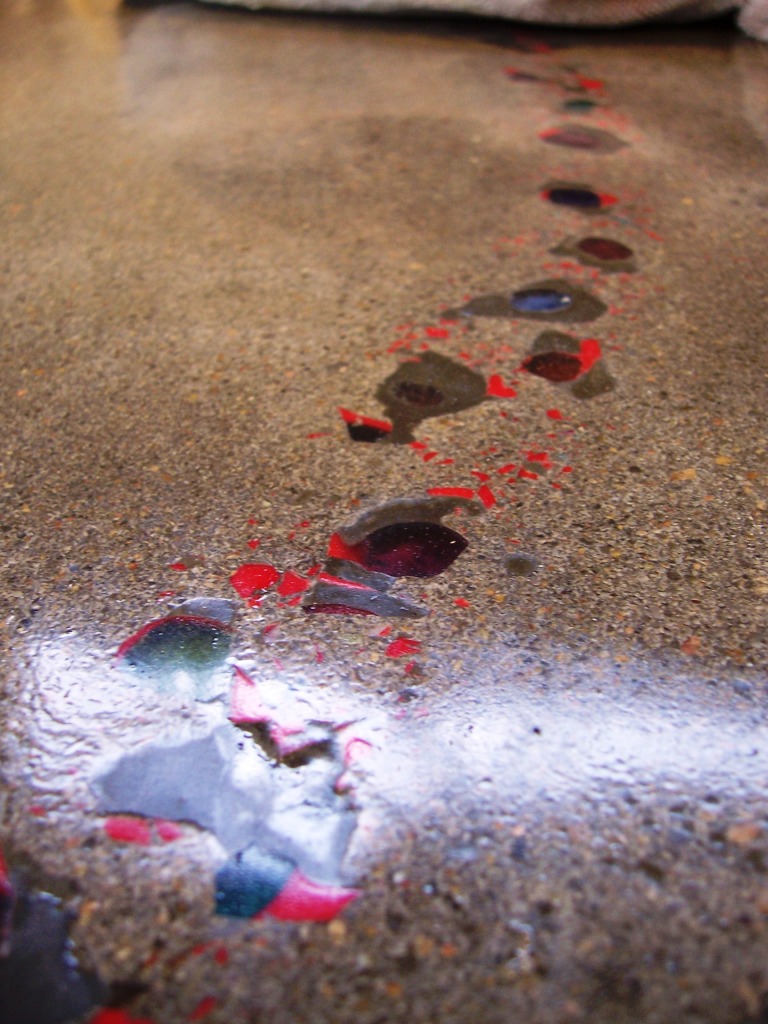
Here is a shot of the crushed Murano glass in the surface. The big pieces are all back-lit with fiber optics.
My cat Portland supervising.
I haven't found a sealing method that I really like. I have tried the Cheng sealer with wax, just wax, and acyclic. None do a good job of penetrating and bringing out the color. I like the idea and durability of traditional epoxies, but they make the concrete look like plastic. I am experimenting with a soy-based eco-friendly epoxy. It is supposed to bring on the color and not make the concrete look like plastic and be UV stable. It mixes in two parts like epoxy but is really thin. There is no odor at all, which is good for inside work.
Here is the applied product. I tried a roller and a brush. It went on a little streaky and became more uniform during drying. I am going to give it a day or so before making a verdict, although so far so good.

Thursday, October 8, 2009

Buffet Top Reveal

The stripped buffet mold. The flowable concrete produced a very smooth texture with very few bugholes, just a couple on the edge.
The fiber optics all stayed in place. I used a razor blade to cut the fibers flush with the concrete.
Now it is curing under wet plastic before grinding.

Sunday, October 4, 2009

Placing the Fiber Optic Concrete

The fiber optic buffet mold has sat covered in the garage for a couple weeks due to some other more pressing things. Today I got back to it.
Finished gluing the fiber optics in.


Some of the first ones came loose. The ones in the mold were fine but the ones glued to the glass pieces came off. I used more hot glue on this round and everything seemed to hold better.
After finishing the mold I was so close, so I whipped up a batch of mortar. Regular concrete would be too stiff and hard to consolidate around the fiber optic lines. There really isn't a good way to consolidate without breaking them loose. The mortar mix I decided on was very fluid. This mix didn't require any consolidation and was self-leveling. It is pretty simple and worked very well. I will probably be using some variant of this on some future projects.
Here are the specs:
- 2.5:1 sand to cementitious materials,
- 5% metakaolin clay,
- 0.4 water-to-cement ratio,
- 1:1 latex admixture to water,
- 3 pcy cellulose microfibers,
- 1.5 pcy polypropylene fibers, and
- a ton of high-range water reducer
I have had problems in the past with the cellulose fibers not dispersing in mortar mixes due to the lack of coarse aggregate. The sand, water, and fibers mixed for 10 minutes before starting to mix the concrete. That seemed to get everything broken up correctly.
I let the mix come to level and let it hang out for an hour or so to begin setting up.
After the concrete stiffened some I was able to lay over the fiber optic lines with less chance of pulling them loose. I laid a couple boards on the mold to help keep the fiber optics pointed in the right direction. The plan is to tape them to the bottom of the mold to hold everything in place. I also lightly troweled down any bumps.
It didn't feel like a pulled any fiber optics loose, but we will have to wait and see. Since I didn't vibrate the concrete at all there may be some extra bugholes. Stay tuned.